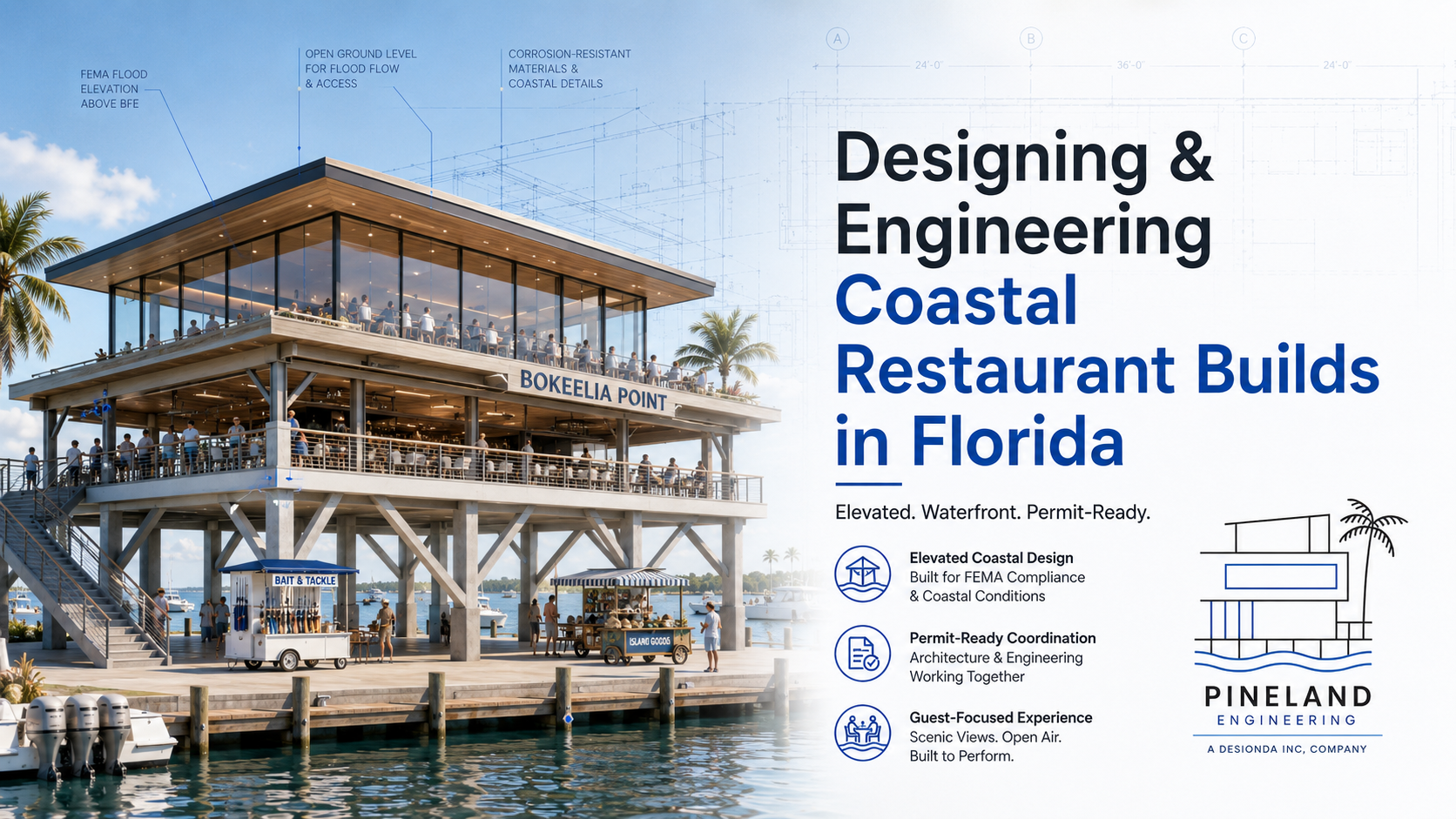
Florida's waterfront restaurant scene is one of the most competitive — and most technically demanding — segments of commercial construction in the state. From the Panhandle to the Keys, coastal restaurants face a unique combination of regulatory requirements, environmental forces, and guest-experience expectations that simply don't exist inland. Getting it right requires an architecture and engineering team that understands FEMA flood maps, coastal wind exposure, corrosion-resistant detailing, and the permitting landscape of Florida's coastal counties.
FEMA Flood Elevation: The Foundation of Every Coastal Restaurant
Every coastal restaurant in Florida sits within or near a FEMA Special Flood Hazard Area (SFHA). In Zone AE, the Flood Insurance Rate Map (FIRM) establishes a Base Flood Elevation (BFE) — the height floodwaters are expected to reach during a 1% annual chance event. Florida's building code requires the lowest finished floor of any new commercial structure to be at or above BFE, and most coastal counties add a freeboard requirement of 1–2 feet above BFE for additional safety margin.
In Zone V (velocity wave action zones), the requirements are even more stringent. The structure must be elevated on open foundations — pilings, columns, or shear walls — so that floodwaters and wave action can pass beneath the building without exerting hydrostatic or hydrodynamic pressure on the walls. This is why the iconic elevated-on-pilings aesthetic of Florida waterfront restaurants isn't just visual — it's a code requirement.
Pineland Engineering designs coastal restaurants to FEMA flood compliance standards statewide. We handle flood elevation certificates, freeboard calculations, and open-foundation structural systems for waterfront commercial projects.
Structural Engineering for Hurricane Wind Loads
Florida's coastal counties sit in the highest wind speed zones in the continental United States. Lee County, Collier County, Charlotte County, and the entire Gulf Coast corridor are subject to design wind speeds of 150–170 mph under ASCE 7-22 and the Florida Building Code. For a coastal restaurant, this means every structural connection — roof-to-wall, wall-to-foundation, canopy-to-frame — must be engineered to resist uplift, lateral, and torsional forces that would destroy a conventionally framed building.
- Continuous load path design from roof to foundation — every connection is calculated and detailed
- High-velocity hurricane zone (HVHZ) product approvals for windows, doors, and glazing systems
- Canopy and shade structure engineering — often the most vulnerable element on a coastal restaurant
- Roof-to-wall connections with hurricane straps, clips, or embedded anchors per FBC requirements
- Lateral force resisting systems (shear walls or moment frames) sized for coastal exposure
Open Ground Level: Design Intent Meets Code Requirement
One of the most distinctive features of a well-designed coastal restaurant is the open ground level — the space beneath the elevated dining floor that allows flood flow and wave action to pass through without building up pressure. In Zone V, this is a hard code requirement: the area below BFE cannot be enclosed with breakaway walls or any material that would obstruct flood flow. In Zone AE, it's a best practice that also creates opportunities for covered outdoor seating, bar areas, and arrival experiences that take advantage of the waterfront setting.
Pineland Engineering designs open-ground-level coastal restaurants with structural systems that make the most of this requirement. Exposed concrete columns, steel moment frames, and heavy timber post-and-beam systems all create dramatic architectural statements while meeting the structural demands of coastal exposure. The ground level becomes part of the guest experience — a shaded, breezy space that transitions visitors from the parking area or dock to the elevated dining room above.
Corrosion-Resistant Materials and Coastal Detailing
Salt air is relentless. Within a mile of the Gulf or Atlantic coast, standard construction materials — galvanized hardware, standard steel, untreated wood — will corrode, rust, or rot within years. A coastal restaurant designed without corrosion-resistant materials will require constant maintenance and premature replacement of structural and architectural components.
- Hot-dip galvanized or stainless steel structural connectors and anchor bolts
- Concrete with low water-cement ratio and adequate cover over reinforcement to resist chloride penetration
- Aluminum or fiberglass railing systems instead of painted steel
- Pressure-treated or composite decking materials rated for ground-contact coastal exposure
- Coated or anodized aluminum storefront and curtain wall systems for glazed enclosures
- Epoxy-coated rebar in concrete slabs and columns within the splash zone
MEP Engineering for Coastal Commercial Kitchens
A coastal restaurant isn't just a structural challenge — it's a full MEP (mechanical, electrical, plumbing) coordination problem. Commercial kitchens require substantial HVAC capacity, grease exhaust systems, makeup air units, and refrigeration loads. In a coastal environment, all of this equipment must be elevated above flood elevation, protected from salt air corrosion, and coordinated with the structural system so that roof penetrations and equipment curbs don't compromise the building envelope.
Electrical systems in coastal restaurants require GFCI protection throughout, corrosion-resistant conduit and enclosures, and careful coordination of panel locations to keep electrical equipment above BFE. Plumbing systems must account for the potential for backflow from storm surge, requiring backflow preventers and check valves at all below-grade connections. Pineland Engineering provides full MEP coordination on coastal restaurant projects, ensuring that every system is designed for the coastal environment and coordinated with the structural and architectural drawings.
Permitting a Coastal Restaurant in Florida
Coastal restaurant permitting in Florida involves multiple agencies and approval layers beyond the standard building permit. Depending on the site, projects may require review by the Florida Department of Environmental Protection (FDEP), the Army Corps of Engineers (USACE), the Southwest Florida Water Management District (SFWMD), and the local county building department — all simultaneously. Projects on or over water require additional environmental permits for impacts to wetlands, seagrass, and navigable waterways.
- Florida Building Code commercial permit with coastal construction setback line (CCSL) compliance
- FDEP coastal construction permit for projects seaward of the CCSL
- Army Corps Section 404/10 permit for projects affecting navigable waters or wetlands
- SFWMD Environmental Resource Permit (ERP) for stormwater management
- Local county zoning and site plan approval with coastal overlay district compliance
- FEMA Elevation Certificate completed by a licensed surveyor before certificate of occupancy
Pineland Engineering coordinates all permit submissions for coastal restaurant projects, working with the owner's legal and environmental consultants to sequence applications and minimize delays. Our in-house architecture (AR102594) and engineering (PE 39202) licenses mean that a single firm can seal all the drawings required for the building permit — no handoffs between separate architecture and engineering firms.
Guest Experience: Designing for the View
The best coastal restaurants in Florida don't just comply with flood and wind requirements — they make those requirements part of the design story. Elevated dining rooms with panoramic glazing. Open-air upper decks with engineered canopy systems. Ground-level covered bars that feel like they're floating over the water. The structural and architectural decisions that are driven by code can also be the decisions that create the most memorable guest experiences.
At Pineland Engineering, we approach coastal restaurant design as an integration of structural performance and spatial quality. The pile caps become the base of a dramatic entry stair. The exposed concrete columns frame the view. The open ground level creates a covered outdoor dining zone that captures the Gulf breeze. Every technical requirement is an opportunity to create something worth visiting.
We design and engineer coastal restaurants across Florida, including:
Get a Quote for Your Coastal Restaurant Project
Get a QuoteDo Florida coastal restaurants need to be elevated above flood elevation?
Yes. The Florida Building Code requires the lowest finished floor of any new commercial structure in a FEMA Special Flood Hazard Area to be at or above the Base Flood Elevation (BFE), plus any local freeboard requirement. In Zone V (wave action zones), the structure must be elevated on open foundations — pilings or columns — so floodwaters can pass beneath without exerting pressure on the walls.
What wind speed must a coastal restaurant in Southwest Florida be designed for?
Coastal restaurants in Lee, Collier, and Charlotte counties must be designed for ultimate design wind speeds of 150–170 mph per ASCE 7-22 and the Florida Building Code. This requires a fully engineered continuous load path from roof to foundation, with hurricane-rated windows, doors, and glazing systems that have been approved for the High-Velocity Hurricane Zone (HVHZ).
What permits does a waterfront restaurant in Florida require?
A coastal restaurant typically requires a Florida Building Code commercial permit, a Florida DEP coastal construction permit (if seaward of the CCSL), an Army Corps of Engineers Section 404/10 permit (if over navigable waters), a SFWMD Environmental Resource Permit, local zoning/site plan approval, and a FEMA Elevation Certificate before certificate of occupancy. Pineland Engineering coordinates all permit submissions.
Can Pineland Engineering handle both the architecture and engineering for a coastal restaurant?
Yes. Pineland Engineering holds both an architecture license (AR102594) and a structural engineering license (PE 39202), allowing us to seal all drawings required for the building permit from a single firm. We also provide full MEP coordination, eliminating the handoffs and communication gaps that slow down multi-firm project teams.
What materials are best for a coastal restaurant in Florida's salt air environment?
Coastal restaurants require corrosion-resistant materials throughout: hot-dip galvanized or stainless steel structural connectors, concrete with epoxy-coated rebar and adequate cover, aluminum or fiberglass railing systems, pressure-treated or composite decking, and coated aluminum storefront systems. Standard galvanized hardware and painted steel will corrode within years in a salt air environment within a mile of the coast.